Escarpment l Merrigong
The Illawarra Escarpment had many uses for the Dharawal, Elouri and Wodi Wodi people. It held our stories in the rock art that is scattered inside the escarpment. There is both Grandfather Mountain (Djembulla – Mt Kembla) and (Geera- Mt Keira). Macquarie pass was a known trading route and at the base the country was utilised to trade Ochre, fish, furs, stone tools and stories. Wiradjuri, Ngunnawal, Yuin, Gannungarra, Dharawal, Elouri, and Wodi Wodi people. Tullimbah was known to utilise the mountain tracks to travel to and from the kangaroo Valley and Nowra regions. Ochres were also extracted from specific sites on the mountain, and more importantly Aboriginal people extracted stones to make s tools and black rock for warmth to keep fires burning. Bark from trees was also extracted to make canoe’s, coolamons, fishing, lines and nets. Plants were utilised for a variety of bush tucker and medicinal uses.
Burra l Eel
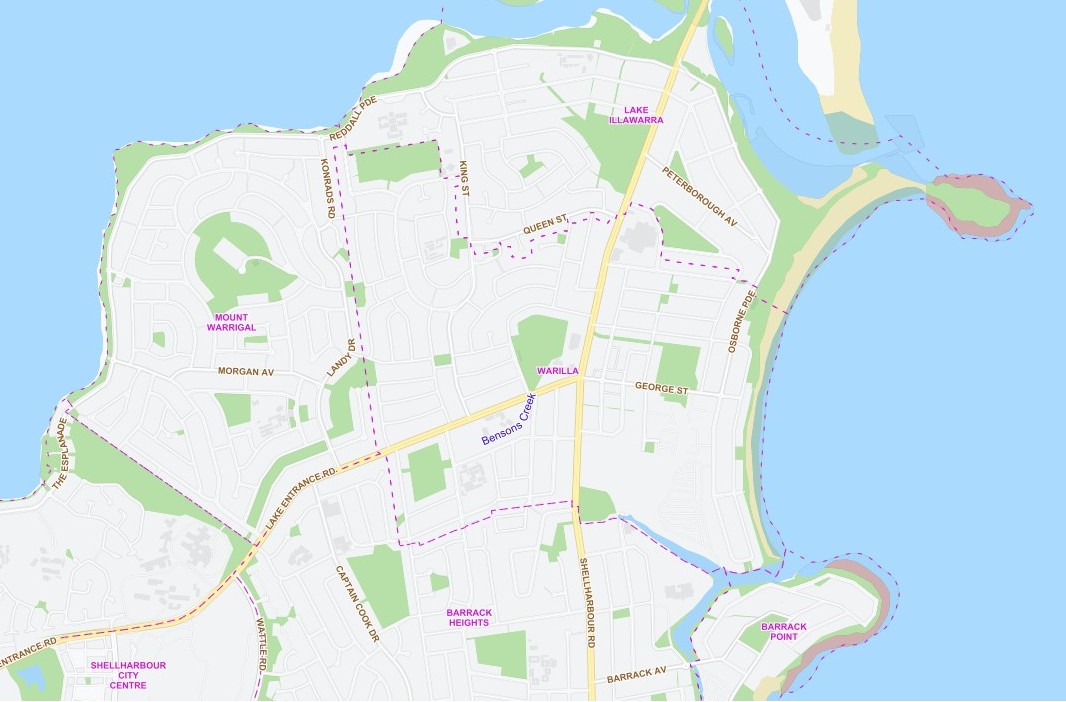
Juborsay (Lake Illawarra) is home to many native animals such as burra (eel), guunyu (black swan) and dhanj (fish). The lake was a significant location for food gathering as Aboriginal women gathered plants from around the lake including warrigal greens, pig face and sea lettuce.
Local Aboriginal women used small canoes (madjari) to go fishing on Juborsay, singing, and chanting while using hand fishing lines to catch their fish.
Gurrangaty is the creation story of the lake and local waterways of the Illawarra. It was told that long ago Gurrangaty roamed the lands, a giant creature with the head of a fish and a long snake-like tail (possibly an eel). Gurrangaty had a dual with another giant creature whose physical features resembled something similar to a dog or cat. This dual was long and went on for many days as the fighters travelled all across the land, from high up in the mountains all the way down to the sea. As the creatures were fighting they created big rifts and holes in the land. Overtime these rifts and tears in the land slowly filled up with water to create streams, creeks and rivers. Eventually Gurrangaty grew tired from the dual and slipped down over the mountains to rest at the bottom of the escarpment. Here Gurrangaty buried deep down into the ground, creating a large round crater. Over time this large crater filled up with water, and Gurrangaty’s resting place became known as Juborsay (Lake Illawarra).
Guunyu l Black Swan
The island to your right is known as Kunanwal (Bevan’s Island) and is one of the locations where guunyu (black swan) nest.
Behind you is Mt Warrigal, also known as Native Dog Hill. Warrigal is the Dharawal word for wild dog (relating to Dingo). It is said that wild dogs wandered through the forest area of Mount Warrigal, and they were known to feast on fish scraps and other carcasses. When local Aboriginal people moved about the area in groups, young children carried hitting sticks and formed circles if warrigals looked like they might attack. The youngest, smallest kids were placed safely in the middle of the circle, and the older, bigger kids formed the outer circle. Mirrigaang were domesticated native dogs that were considered companion animals.
As you enjoy the view of Juborsay (Lake Illawarra) and Merrigong (the escarpment) you can picture the seasonal movements of local Aboriginal people as they travelled across Dharawal Country. Their movements were guided by the local flora and fauna, and moved as the seasons changed. Gunyahs were used as a dwelling during the warmer months, sheltering the Dharawal, Elouri, and Wodi Wodi people from the heat of Grandfather Sun, the southerly winds, and the consistent rainfall in the warm wet season. A gunyah is a short-term house, home, humpy, or dwelling made of bark and tree branches. In Dharawal Country these were often found closer to the rivers, lake, estuaries, and ocean. During the colder months local Aboriginal people would move up into Merrigong to find shelter in the rock caves and platforms, protecting themselves from heavy rain, wind, and the cold.
Gari l Snake
Aboriginal People harvested the seafood and bush tucker that was plentiful surrounding Juborsay (Lake Illawarra). They farmed and harvested based on their nutritional, environmental and cultural needs, and lived by the following rules:
- You do not take more than you need,
- You must leave enough behind for those who come in the future and,
- You must record what was taken - this was to inform those who came after you of what had already been hunted and harvested in the area.
Plants hold great significance to the traditional custodians – as a source of food, medicine, and a seasonal calendar. On Dharawal country there are 6 seasons which are tracked by the movement of native fauna and the blooming of native flora. As you walk along the edges of Juborsay you will see a variety of native flora.
Banksia trees have large yellow flowers that have soft yet strong and spiky petals. The flowers provide nectar to make a sweet drink and can be used as a hairbrush as the honey nectar helps to tame hair. The large seed pods are used to keep fires burning warm like coal. They were used in madjari (canoes) on a coolamon, or small bed of sand to keep small fires for warmth and cooking while people were fishing.
Casuarina trees are very tall with long needle-like leaves and tiny, round, bumpy seed pods. The hard wood of the tree was used to make tools and weapons. Small children were told to wait by them if they became lost, because they were the tallest trees in the canopy and a safe space to wait. Gari (snakes) stay away from the bottom of casuarina trees because the needle leaves and bumpy seed pods irritate their skin.
Juborsay l Lake Illawarra
Lake Illawarra perhaps one of the centrepieces of life for the Dharawal, Elouri and Wodi Wodi peoples. The lake was a lifestyle it held some of our stories such as Garrungaty and Gang man gang. It was integral part of our diet providing one of our largest food sources. The lake took us from salt water to fresh water and all the flora helped us understand where we needed to be. Some areas around the lake for instance near the entrance between Warilla and Windang Beach were initially only passable on low tide. This area was also known for the many sharks that frequented this area so the Dharawal, Elouri and Wodi Wodi people ensured they did not cross this area mid tide or high tide.
Juborsay was significant place for fishing using nets made from stringy bark and fishing from bark canoes. Fishing was done both during the day and at night. Black rock was placed on a bed of sand in a coolamon to create light and provide warmth so fisherman could see at night. Prawning was also a regular occurrence and this was governed by the season and by Grandmother Moon. The Dharawal Elouri and Wodi Wodi people relied on the flora, the fauna, the stars, their stories to ensure the maintained the waterways, the food sources and their Country including Sea Country and Juborsay.
Gang Man Gang l Windang Island
In Dharawal Country all the animals lived in another place past the sea. In this time, they moved between their human and animal forms. For their survival, they needed to find new hunting grounds. Whale, had the largest canoe, he would not lend his big canoe to any of the others. The others needed Whale’s canoe, and hoped he would share, he never did, he always kept a close guard on it.
The Whale’s close friend called ghoon a ghaan (Starfish), joined garilwa (Koala) and others to make a plan to take Whale’s canoe. Goon a ghaan (Starfish) said to Whale, “you have heaps of mula’s (head lice); let me catch them for you.” The whale agreed to let starfish help him.
Whale tied up his canoe next to a big rock which Whale and Starfish then sat on. After a little time Starfish then gave a signal, all the others had gathered nearby. They were waiting for their chance to go in the canoe. Scratching behind Whales ears so he could not hear any noises, the others quietly began to row away. whale so worried about his canoe, just wanted to look at it, he saw that his canoe was gone, He saw the people rowing his canoe far away. Whale was angry and began to fight with Starfish, the others in the boat became worried that whale would catch them. The garwila with his strong arms rowed faster. The canoe was soon beside the land, the animals fled to land. Garwila jumped up and down putting a hole in the canoe. He then pushed it out into the mouth of Lake Illawarra soon the saltwater wind and sand turned it to rock.
Garwila ran to hide in the trees, Ghoon a ghaan is still at the bottom of rock pools, and whale travels up and down the coast looking for his canoe and the others.
Ghadu l Ocean
Sea Country was/is just as important to the Dharawal, Elouri, and Wodi Wodi people as the land and sky. The Sea holds stories, and underneath the water in the caves rock art tells the stories of ancestors passed. The sea provided other rich food source, from fish, lobsters, abalone, and sea grass. The whales one of the totems of the Dharawal people were the law holders of the sea. On the shores you could gather pippies, bimbala’s, sea weed, and oysters. These provided a stable diet and the shells could be used to make fish hooks, spear heads, and jewellery for performances. Midden sites that exist along the coast line show the extensive long term use of the ocean by the Dharawal, Elouri, and Wodi Wodi people. Midden sites can be found at Bass Point and along the shores of Lake Illawarra. Middens are layers and layers of shells, some are tools sites and some are feeding sites. The middens locally have been dated back as far as 30,000years. Rock quarries, and ochres sites can be found near the sea, as well as some axe grinding sites, and rock oven also known as bush ovens. The sea also provided a playground for the people, surfing in the waves with their canoes, and bark boards.
Burri Burri l Humpback Whale
Barrack Point, Bass Point and Hill 60 are all vantage points along the local Illawarra coastline where spotters would stand on the headland and direct the fisherman in their madjari (canoes) or light fires as a signal to quickly pass on specific messages to people far away. Today these vantage points are used to watch burri burri (humpback whales) as they migrate along the coast.
Aboriginal men fished in the ocean with the help of madjari and fish spotters. The fish spotters stood up on the headlands and the high sand hills that surrounded the ocean and directed those in madjari to where the schools of fish were. It was important for the spotters to direct the fisherman away from the lead/scout fish as these were the oldest and wisest and were the protectors. There are middens all along the coast and shores of Juborsay (Lake Illawarra). Middens are layers and layers of shells, buried amongst the sand. Some are tools sites, and some are feeding sites. They are used to assist in understanding what the local Aboriginal community did in specific areas. These sites were used to record what had been harvested, eaten, or used to make tools within the local area.